



How to Clean Car Seats and Protect Them Properly
You open your car door and... what do you feel? The smell of a new interior that gives a sense of freshness? Or the stale aroma of spilled coffee and dust? The condition of your car seats is a business card of your attitude towards your vehicle, an important element of your health, and a factor that directly affects the car's resale value.
Dirty upholstery is a breeding ground for bacteria, a source of allergens, and unpleasant odors. And cracked leather or faded fabric can reduce the value of a car by hundreds, if not thousands, of euros.
And if you don't know how to clean leather seats and have no idea how to care for fabric–covered seats – our article is just for you! Read carefully. There is a lot of useful and interesting information ahead.
Identifying the material type: what's in your cabin?
Before you buy a leather seat cleaner and grab a brush and chemicals, you need to know exactly what you are dealing with. The wrong product can permanently ruin the upholstery.
- Leather Seats. The most desirable, but also the most demanding material. To distinguish natural leather from artificial leather (leatherette), put a drop of water on an inconspicuous area. Natural leather will absorb it in a few seconds, while the drop will simply roll off the leatherette.
- Fabric Seats. The most common option. The fabric can vary: durable and wear–resistant jacquard, soft and pleasant to the touch velour, or modern microfiber. Caring for them is easier, but they absorb stains much more readily.
- Combined Materials. Alcantara (artificial suede) requires a particularly delicate approach. Vinyl is often used on the sides of the seats. And perforated leather needs special cleaning methods to avoid clogging the holes.
Preparation for cleaning: tools and products
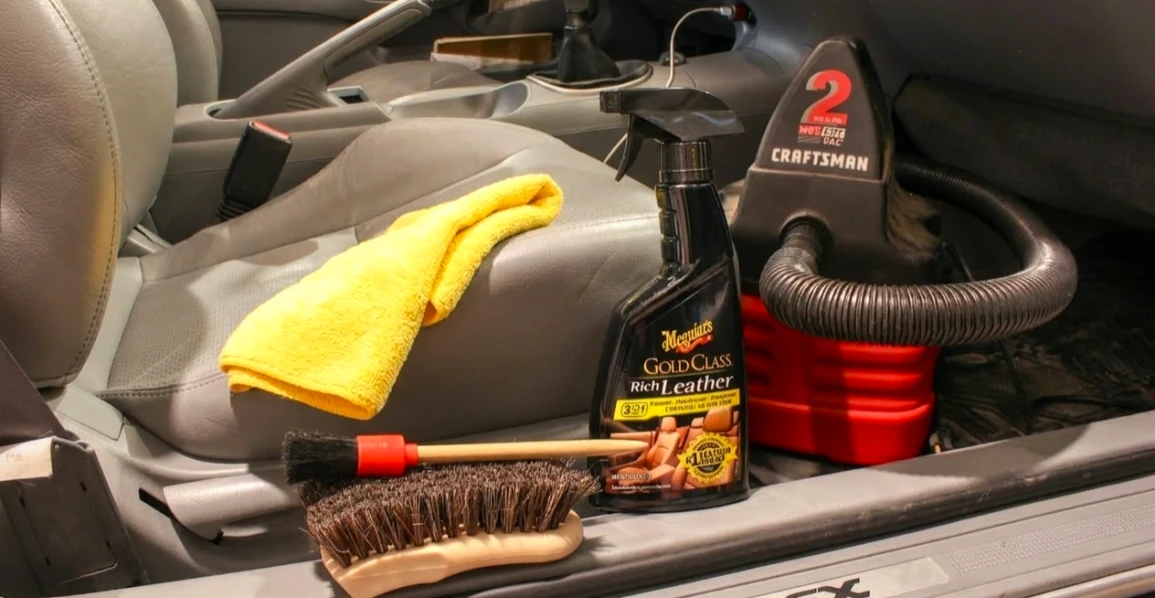
The right arsenal is half the battle. Below, we list the basic set of tools. So, first, buy a vacuum cleaner with attachments. Be sure to have a narrow crevice tool and a brush attachment with soft bristles. You will also need a soft brush made of natural horsehair for leather, and a brush with medium–stiffness bristles for fabric. You will also need microfiber towels. You need at least 3–4 clean and dry towels.
For leather, you will need:
- Cleaner. A specialized cleaner for leather seats. It should be pH–neutral.
- Conditioner. Restores elasticity and protects against drying out.
- Protectant. Creates an invisible barrier on the surface against dirt and UV rays.
And don't forget about products for fabric. A foam cleaner – lifts dirt from deep within the fibers, and a stain remover – for tackling tough stains.
What NOT to use: Never use aggressive household cleaners, dishwashing liquids, acetone, or bleach to clean the interior. They can destroy the material's structure and spoil the color.
Step-by-step guide: cleaning leather seats
Working with leather requires gentleness and a strict sequence.
- Preliminary Preparation. Thoroughly vacuum the seats, paying special attention to the seams and folds where most dirt and abrasive particles accumulate.
- Testing the Product. Before you how to clean leather seats, always test the cleaner on an inconspicuous area (for example, on the lower part of the seat). Make sure it does not change the color or texture of the leather.
- Cleaning. Apply a small amount of cleaner to the brush, not directly onto the seat. Gently, without strong pressure, work a small section (e.g., one panel of the seat) in a circular motion. Immediately wipe off the resulting foam, which has absorbed the dirt, with a clean, damp microfiber towel. Then wipe the area dry. Repeat until the entire seat is clean.
- Conditioning. After a full cleaning and drying, apply conditioner to the seat. It will restore the leather's moisture balance, making it soft and supple. Apply a small amount to an applicator and spread it evenly over the surface. Let it absorb for 15–20 minutes and remove any excess with a dry microfiber towel.
- Protection. The final step is applying a protective coating. It will create a barrier that repels dirt, moisture, and protects against fading from the sun. This is the best answer to the question of how to protect leather car seats.
Fabric seats: effective cleaning methods
Fabric car seat cleaning depends on the degree of soiling.
Cleaning Type | When to Use | Main Tool |
Dry | Regular maintenance, removing dust and crumbs | Vacuum cleaner, brush |
Wet (Foam) | Removing general dirt, freshening up the look | Foam cleaner, brush, microfiber |
Extractor | Deep cleaning, removing stubborn stains | Wet vacuum (extractor) |
Step-by-step process for wet cleaning:
- Thoroughly vacuum the surface.
- Evenly spray foam cleaner on a small area.
- Gently agitate the foam with a brush to allow it to penetrate the fibers.
- Wait a few minutes for the chemical to work.
- Remove the dirty foam and moisture with a clean microfiber towel or a wet vacuum.
- Let the seats dry completely, leaving the doors or windows open.
For removing tough stains (coffee, grease, ink), use specialized stain removers, following the manufacturer's instructions.
Tackling tough stains
Even with the most careful use, accidental stains are unavoidable. The main rule for dealing with them is to act as quickly as possible. A fresh stain is much easier to remove than one that has dried and set into the fabric fibers. There are proven methods for different types of stains. And here are a few tips for removing the most common household stains:
Coffee, wine, sauces
Blot fresh stains immediately with a clean, dry cloth to remove excess liquid. Then treat the area with a universal fabric cleaner.
Grease
Sprinkle a fresh grease stain with baking soda, cornstarch, or talcum powder. These absorbents will soak up the bulk of the grease. After that, use a specialized stain remover.
Odors
After removing the source of the contamination, it is important to eliminate the odor itself. Treat the cabin with an odor neutralizer that chemically destroys the molecules, rather than just masking them like regular air fresheners.
Professional secrets and life hacks
In addition to standard procedures, experienced detailers have a few tricks up their sleeve that allow for better results and handling of non–standard tasks. These techniques can also be used at home with caution. Here are a few professional tips that will simplify interior care:
- Steam Instead of Chemicals. A steam cleaner is a powerful tool for cleaning and disinfecting fabric seats without the use of aggressive chemicals. Hot steam under pressure softens dirt and kills bacteria.
- Melamine Sponge. Gently, without strong pressure, it can help remove stubborn dirt from textured plastic (e.g., on sills or door panels), but never use it on leather, glossy, or painted surfaces.
- Emergency Help. Always keep a pack of wet wipes (alcohol–free) and a small microfiber towel in the glove compartment. The ability to immediately blot a fresh stain is your main trump card in the fight for cleanliness.
Prevention and regular care
The best way to keep seats in perfect condition is to prevent heavy soiling. Simple habits:
- Weekly: Vacuum the interior.
- Monthly: Wipe leather seats with a damp microfiber towel, and brush fabric ones.
- Every 3–4 months: Perform a full care cycle for leather with conditioner and protectant.
Using high–quality protective covers, especially if you have children or pets, can significantly extend the life of the original upholstery.
When to turn to professionals
If you are faced with very difficult stains (paint, glue), if a moldy smell appears in the cabin, or if you are simply not confident in your abilities, it is better to entrust the work to professionals. Professional dry cleaning using an extractor and a steam cleaner can work wonders.
Investing in durability: products and equipment
The modern market offers a wide range of products for interior care.
Segment | Brand Examples | Who It's For |
Budget | Turtle Wax, Grass | For maintenance cleaning and simple stains. |
Mid–range | Koch Chemie, Meguiar's, Chemical Guys | Optimal price/quality ratio for enthusiasts. |
Premium | LeTech, Colourlock, Swissvax | for caring for expensive leather and achieving maximum results. |
Choosing the best car leather conditioner depends on the type and condition of your leather. For new leather, light formulas are suitable; for old and dry leather, richer ones with oils are better.
Clean seats as a lifestyle
A clean and well-kept interior is not just beautiful. It is your daily comfort, a concern for your health, and a profitable investment in the future of your car. Proper and regular care, whether it's car upholstery cleaning or delicate work with leather, preserves the materials in their original condition for many years.
We hope our car seat cleaning tips will help you with this. Remember that the best cleaning method is the one that is right for your car. And understanding how to clean leather car seats or remove a stain from fabric turns a routine task into an understandable and satisfying process.

