



Mastering Different Types of Parking: From Angle to Perpendicular

Parking is a maneuver that can make even drivers with years of experience nervous. Crowded city streets and tight shopping center parking lots turn a simple task into a real challenge. Novices often make the same mistakes – misjudging the car's dimensions, turning the steering wheel too much or not enough, and ending up scraping their wheels on curbs or inconveniencing others.
Knowing how to park correctly and confidently is not a matter of prestige but the foundation of safe and comfortable driving. This skill saves you time, spares your nerves, and protects your car and others' property from damage. In this article, we will break down the main types of parking, provide clear, step-by-step algorithms, and offer tips that will help you transform this stressful maneuver into a smooth, automatic motion.
The Main Types of Parking and Their Features
First, you need to understand the types of parking spaces you will encounter. There are three main ones, and each requires its own approach and technique. The method you choose will depend on the layout, available space, and the traffic situation.
Parking Types Comparison Table
Parking Type | Description | Where It's Found | Pros | Cons |
Parallel | Positioning the car in a line with other vehicles along the curb. | City streets, narrow courtyards. | Saves space along the road. | Requires high precision and skill; difficult for beginners. |
Perpendicular | Parking at a 90° angle to the curb or driving aisle. | Mall parking lots, residential complexes, office buildings. | Accommodates many cars in a limited area. | Exiting is difficult if parked head-in; requires more room to maneuver. |
Angle | Parking at an angle (usually 45°) to the driving aisle. | Large parking lots, stadium parking. | Easy entry; safer and more convenient reverse exit. | Uses space less efficiently than perpendicular parking. |
Mastering each of these types will make you a versatile driver, ready for any parking situation. A successful horizontal parking car maneuver in reverse is considered a sign of high skill, while angle parking is the most beginner-friendly.
The Basic Rules of Safe Parking
Regardless of the parking type, several fundamental rules are key to success.
- First and foremost is choosing the right spot. Don't try to squeeze into a space that is too small. The ideal spot for parallel parking is about 1.5 times the length of your car. Ensure you are not blocking driveways or pedestrian crossings and are not violating any rules. Assess for hidden obstacles like high curbs, poles, trees, or protruding rebar.
- Second is to make maximum use of your mirrors and cameras. Your mirrors are your best friends. Before starting the maneuver, adjust them so you can clearly see your wheels and the parking lines. You can tilt the right-side mirror down slightly to monitor the distance to the curb. Rear-view cameras and 360-degree view systems make the task much easier, but they do not replace the need to physically look around.
- Third is to control your dimensions and distance. You must have a feel for the size of your car. Understanding where your bumper ends and how far your wheels are comes only with practice. Use adjacent cars, painted lines, and other visible objects as reference points.
- And fourth is to maintain minimal speed and smooth movements. Parking is no place to rush. Move at the slowest possible speed, working the steering wheel and pedals smoothly. The slower you go, the more time you have to assess the situation, make decisions, and correct any mistakes.
Understanding the Mechanics of Parking Maneuvers
Let's move from theory to application by dissecting the geometry of the two primary reverse parking maneuvers. Remember, reversing into a space is the key to a safe exit. It ensures you won't have to back out blindly into traffic; instead, you will drive forward with a full, unobstructed view of your surroundings.
Parallel Parking: A Three-Step Geometric Execution
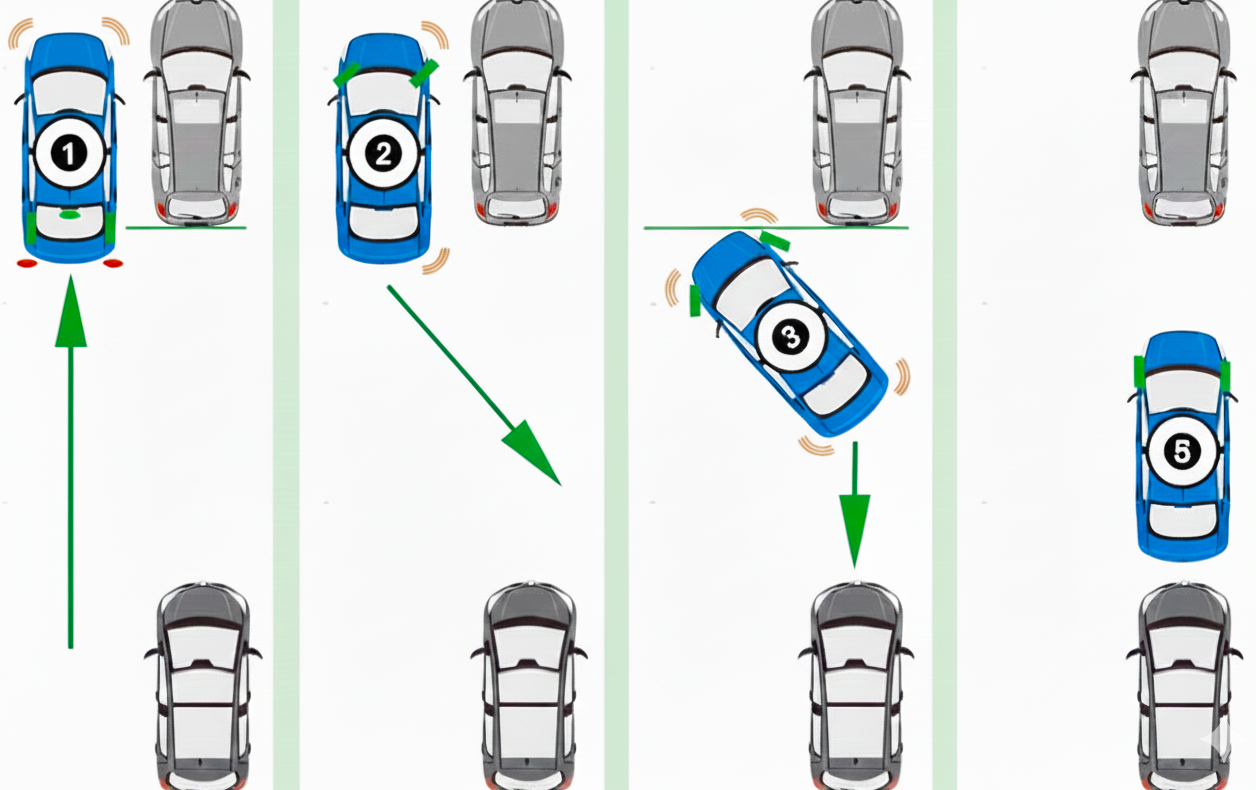
This maneuver requires a driver to have a sense of spatial geometry and to follow reference points precisely. Your goal is to position your car in a confined space between two other vehicles (let's call them the front car and the rear car).
- Assume the Starting Position. Proper alignment is crucial. Pull up alongside the front car, ensuring your rear bumpers are in line. Maintain a side distance of about half a meter (roughly 2 feet) – just enough space to turn your wheel without making contact.
- Initiate the Entry Arc. The critical phase begins as you start reversing with the steering wheel turned fully to the right. Your focus should be on your left side-view mirror. Watch for the right headlight of the rear car to appear in the mirror. The moment it does, stop immediately. At this point, your vehicle is angled perfectly (at about 45 degrees) to enter the space.
- Align and Finalize. Now, straighten the steering wheel and continue moving backward. As you reverse on this diagonal path, the front of your car will swing left, safely clearing the front car. Continue until your right front wheel aligns with the rear bumper of the front car. From here, turn the steering wheel fully to the left and complete the maneuver by backing up slowly. Monitor the distance to the curb in your right mirror and to the rear car using your camera or sensors. Once positioned, straighten the wheels and pull forward slightly to center your car in the space.
Perpendicular Parking: Simplicity Through Precision
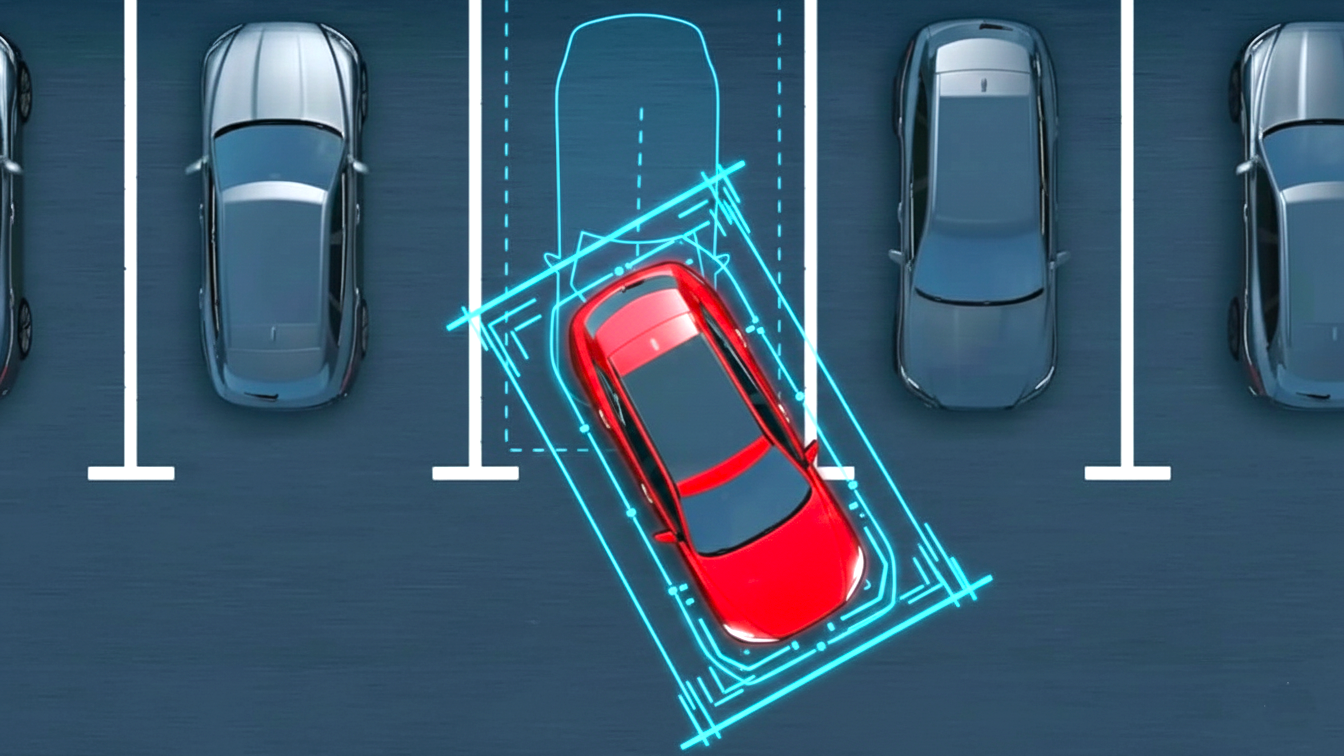
This maneuver is less complex than parallel parking but demands just as much care. The secret to success lies in identifying the single correct point to begin your turn.
- As you drive past the desired space on your right, your objective is to stop the moment your car's rear bumper clears the far line of that parking spot.
- Maintain a side distance of about one meter (3 feet) from the already parked cars.
- Now, by turning the steering wheel fully to the right and reversing, you will pivot your car cleanly into the space. Your primary focus should be on the left mirror to ensure you don't clip the car on your left.
- With the correct starting position, your right side will clear automatically.
- Once your car is parallel to the lines, straighten the steering wheel and back straight in. The result will be a perfect perpendicular parking job with minimal need for correction.
Modern Driver Assistance Systems

Automotive technology is evolving at an impressive pace, and parking is one of the areas where innovation is felt the most. What once required skill, patience, and a perfect sense of distance is now done more easily, faster, and significantly safer.
Modern driver assistance systems not only make parking more comfortable but also reduce the risk of damage, save time, and help even in the tightest urban environments. Here are the key technologies to consider when choosing a vehicle.
1. Parking Sensors (Parktronic Systems)
This is one of the most common and useful parking aids. Built-in sensors detect obstacles the driver may not notice—curbs, low barriers, or corners of nearby cars.
What parking sensors provide:
- audible alerts that help determine the exact distance;
- warnings about hidden or low obstacles;
- prevention of minor collisions while maneuvering;
- convenience for both beginners and experienced drivers.
Modern systems often support adjustable sound levels, on-screen visualization, and even intelligent side-obstacle recognition.
2. Rear-View Camera
This feature has become almost a standard—and for good reason. Visual control dramatically increases safety.
Advantages of a rear-view camera:
- a wide viewing angle unavailable through mirrors;
- dynamic guidelines showing the vehicle’s predicted path;
- helpful for parallel parking, exiting narrow courtyards, and navigating busy parking lots in reverse;
- allows the driver to spot children, animals, or objects that might otherwise go unnoticed.
Some cameras offer night mode and high resolution, providing a clear image even in low-light conditions.
3. 360-Degree Surround-View System
This is a premium-level tool for those who value maximum control. Several cameras placed around the vehicle create a unified panoramic image as if you were looking at the car from above.
What the 360° system does:
- generates a “bird’s-eye view” of the surroundings;
- assists in tight spaces, parking garages, and confined spots;
- minimizes the risk of hitting curbs, concrete pillars, or nearby vehicles;
- allows switching between different viewing modes: front, side, rear, or a combined perspective.
This is one of the most useful systems for navigating urban environments.
4. Automatic Parking System
The ultimate convenience: the car handles the entire parking process itself. The driver only monitors the maneuver and confirms actions with a button.
How it works:
- the vehicle scans the area and identifies a suitable parking spot;
- calculates the trajectory automatically;
- controls the steering, acceleration, and braking (depending on the system type);
- can park both parallel and perpendicular.
This feature is especially valuable in densely populated cities, where precise maneuvering is essential.
Parking Rules and Prohibitions

Knowing how to technically park your car correctly is only half the battle. The other half is knowing and obeying traffic laws. Improper parking not only risks a fine and getting towed but also creates a real danger for pedestrians and other drivers by obstructing views and blocking passage.
A List of Places Where Parking is Prohibited:
- On pedestrian crossings and within 5 meters (15 feet) before them.
- On tram tracks or in close proximity to them.
- In tunnels, on bridges, and on overpasses.
- At intersections and within 5 meters (15 feet) of the edge of the intersecting roadway.
- In places where the vehicle would obstruct traffic signals or road signs.
- In designated disabled parking spaces (without a valid permit).
Tips for Beginner Drivers

The fear of parking is normal for a new driver. The key is not to avoid it but to practice systematically, turning fear into confidence. The goal of diagonal parking, for instance, is often to make this process less intimidating.
Three Steps to Confident Parking:
- Find a safe practice area. An empty parking lot at a supermarket early in the morning or late at night is ideal. There's no risk of damaging someone else's property, and you can practice maneuvers calmly.
- Create training guides. Use cardboard boxes, plastic bottles filled with water, or traffic cones to simulate the boundaries of a parking space and adjacent cars.
- Practice until it's automatic. Repeat each type of parking dozens of times until the movements become intuitive and deliberate. Focus on smoothness, not speed.
For example, a useful reference point for parallel parking in many cars is the moment the rear door handle aligns with the curb. Find similar "hacks" for your own car – they will boost your confidence.
Conclusion
Proper parking is a skill that comes with practice. It consists of knowing the algorithms, having a feel for your car's dimensions, and showing respect for other road users. Whether it's a simple angle parking spot at the store or a complex parallel maneuver downtown, the key to success is calmness, precision, and not rushing.
Practice, don't be afraid to use modern technology as an aid, and remember that every successful maneuver builds your confidence behind the wheel. A neatly parked car is the hallmark of a good driver.

