



How Do Airbags Work and Why Every Car Airbag Matters for Safety
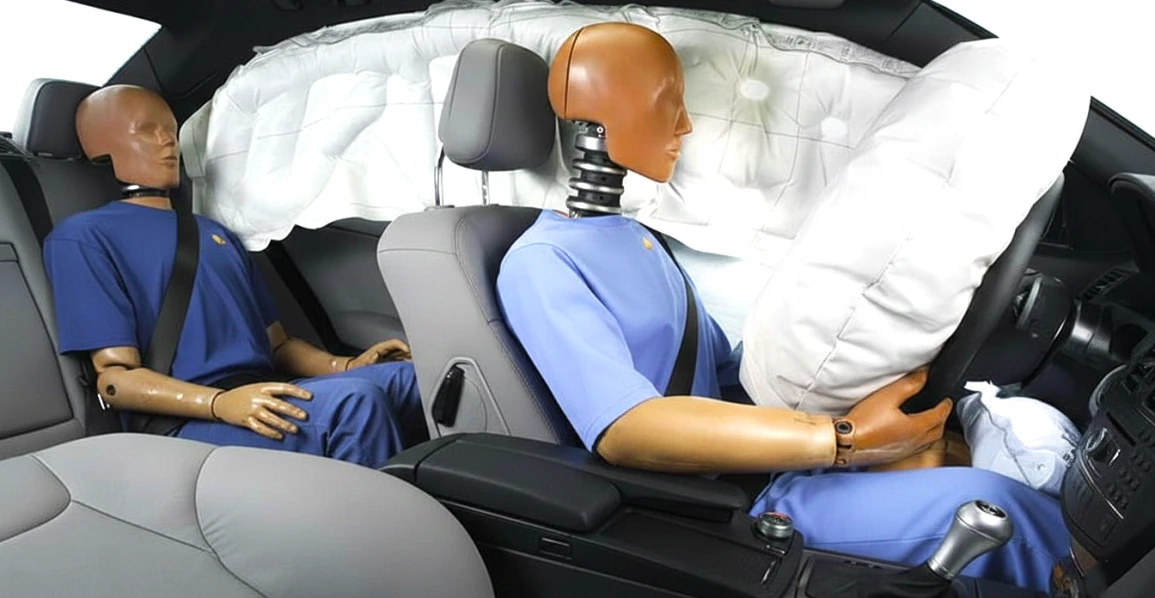
To use a passive safety system correctly, it helps to understand what is airbag in car and what task it performs. An airbag, at the moment of a crash, reduces impact to the chest and lowers the risk of contact with hard interior parts. But it does not work “on its own”: by design and by control logic, it is intended to work together with the seat belt, pretensioners, and the vehicle’s structural frame.
According to the NHTSA, frontal airbags have saved more than 50,000 lives over the years, which is why the topic of how they are built is of interest to drivers.
History of airbags
The first ideas appeared long before today’s “smart” systems. One of the well-known early patents in the United States is associated with John Hetrick: he filed his application in 1952, and the patent was issued in 1953. At that time, the challenge was not the concept of a “bag that softens the blow” itself, but the technology: it was necessary to detect a crash very quickly and accurately, and then instantly produce a large volume of gas. Mid-20th-century electronics and the sensors of that era were not fast or reliable enough for such a task.
From the 1950s to the 1970s, development moved in several directions:
- improved acceleration sensors;
- more accurate measurements of the “crash pulse” appeared;
- pyrotechnic compounds capable of releasing gas in fractions of a second were developed.
When automotive electronics became widespread and resistant to vibration and temperature changes, manufacturers were able to install a control unit that compares sensor signals with algorithms and decides whether to deploy airbags or not.
In parallel, safety standards were changing. In Europe, UNECE rules played an important role (for example, requirements for frontal and side impacts), which define test methods and passenger protection criteria. These rules do not “require an airbag in every location,” but in practice they push manufacturers toward comprehensive solutions: the body’s structural elements, seat belts, load limiters, and airbags are engineered as a single system.
Main types of airbags
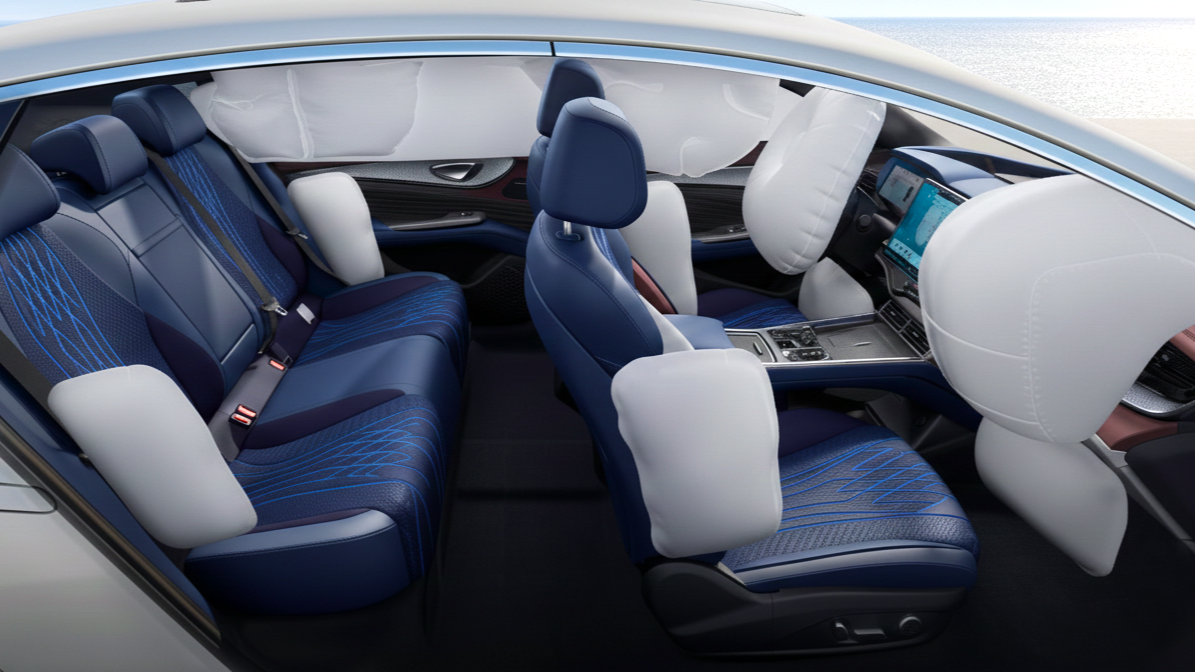
A car airbagcan be frontal, side, knee, and even integrated into a belt or a seat—everything depends on the vehicle class and protection scenarios. It is important to understand that different airbags “work for different directions of impact” and deploy only when the algorithm detects the corresponding crash pattern.
Below are the main types that are most commonly found:
- Frontal airbags (driver and passenger). They protect in a frontal collision, reducing the risk of the head/chest striking the steering wheel, dashboard, and pillars. The driver airbag is usually smaller in volume; the passenger airbag is larger and often has separate modes/stages of deployment.
- Side airbags. They can be “torso” airbags (in the seat/backrest, protecting the chest and pelvis) and curtains (in the upper part of the cabin, covering the window area and protecting the head). According to the IIHS, side airbags with head protection reduce the risk of driver death in a driver-side impact by about 37% (in a study of passenger cars).
- Knee and additional airbags. A knee airbag helps keep the legs and pelvis positioned, reduces the risk of “submarining” under the belt, and lowers the load on the femur bones. Additional airbags can be installed for center seats, rear passengers, and specific scenarios.
- Features for children and special seats. For a child, the key factor is distance to the airbag and the direction of deployment. That is why manufacturers provide deactivation/control of the front passenger airbag, warning labels, and requirements for placing child seats. European documents separately specify requirements for warnings for seats where a child restraint system may be installed.
The main point: air bags in cars are engineered not “for a nice SRS badge,” but for specific injury-prone zones and types of impacts. Therefore, the number of airbags by itself is not equal to safety—what matters more is how they are calibrated and how a person sits.
Airbag design
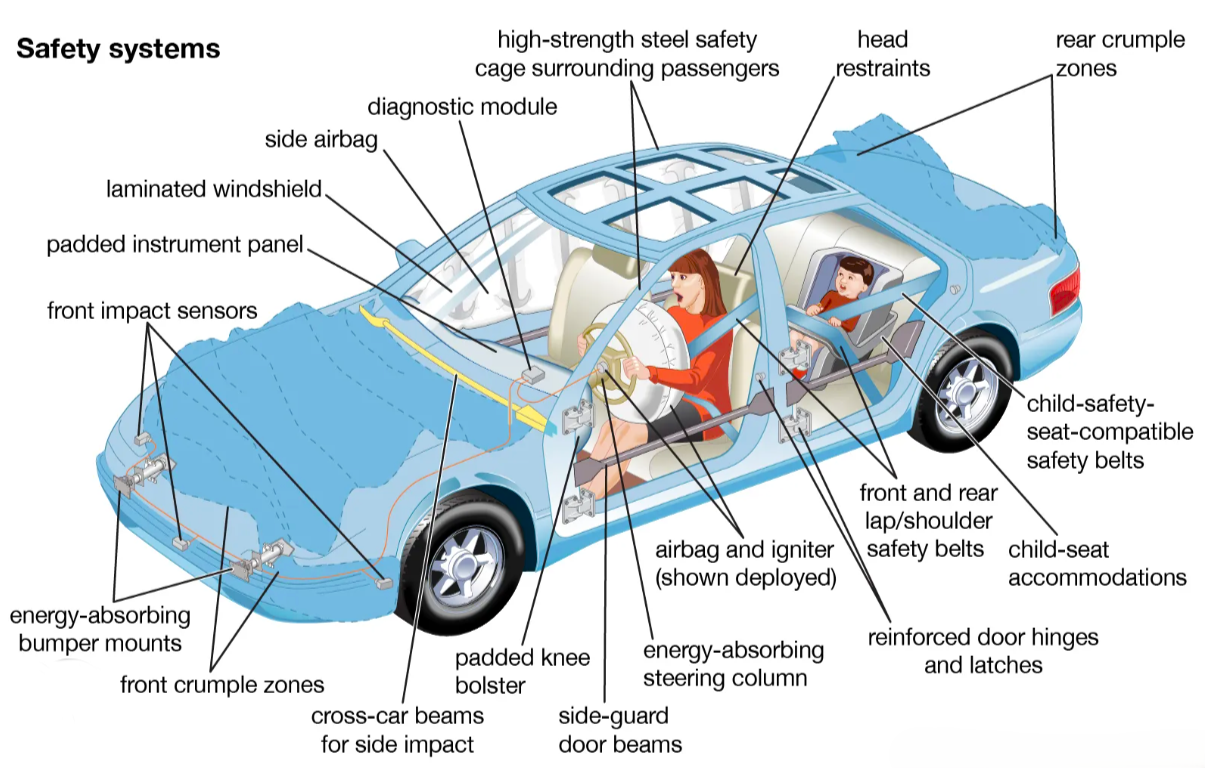
Structurally, the SRS module (Supplemental Restraint System) is a set of components, each with its own strict function. Simply put, the system must:
- detect a serious crash;
- make a decision within milliseconds;
- deploy the required airbags and tighten the seat belts;
- do this predictably and repeatedly across a wide range of temperatures and conditions.
The main elements look like this:
- Crash sensors. Most often these are accelerometers (acceleration/deceleration sensors) in the control unit and/or separate frontal/side sensors in the front of the body, pillars, and doors. They do not directly “measure impact force”—they record acceleration and the shape of the crash pulse. Additional sensors can include door pressure sensors for side impacts, rollover sensors, as well as seat position and occupant presence sensors.
- Electronic control unit (ECU/SRS). This is the brain of the system. It continuously analyzes signals, compares them with thresholds and templates of crash events. The logic takes into account not only the peak acceleration but also the duration of the pulse: a short jolt from a bump is not the same as body deformation in a crash. In modern systems, the ECU also considers whether the belt is fastened, the seat position, the passenger’s mass/presence, and sometimes data from other vehicle modules.
- Inflator module and gas. In most vehicles, a pyrotechnic gas generator is used: when commanded by the ECU, an igniter fires, a chemical reaction begins, gas is produced, and it fills the bag. There are also hybrid solutions (part of the gas is stored, part is generated by the reaction), as well as designs with filters and cooling to reduce temperature and the amount of solid particles.
- Airbag fabric and venting design. The bag is sewn from strong synthetic fabric (usually nylon-based), designed for instant deployment and high loads. It has vent holes: they are needed so the airbag is not rigid and works as a damper—gas exits in a controlled way while the body “presses into” the bag. You may also see dust during deployment—these are residues of technological coatings and products from the inflator’s operation, which are not “fire smoke” but can irritate the respiratory tract.
It is the combination of sensors, the ECU, and the correct deployment mechanics that determines how safe and predictable the system will be.
How an airbag deploys in a crash
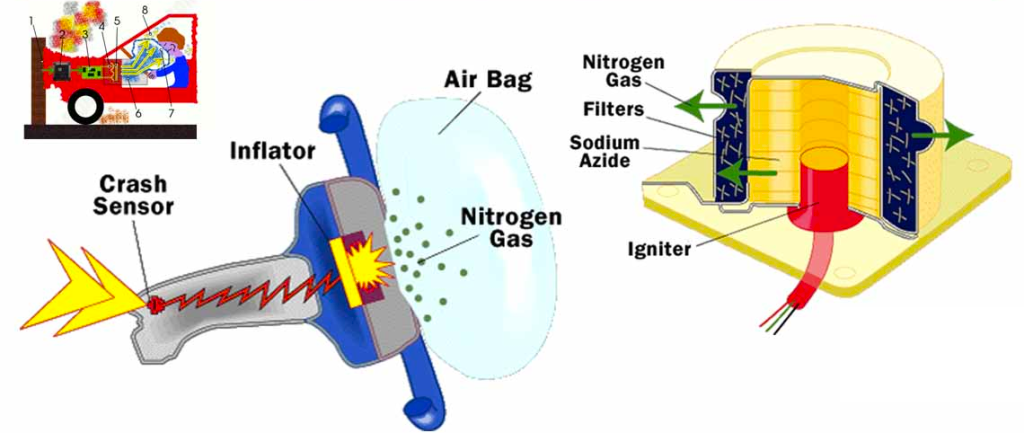
In a real crash, everything happens faster than a person can blink. The sequence looks roughly like this:
- Start of impact and body deformation. The vehicle experiences deceleration, speed changes, and the body begins to absorb energy.
- Signal collection by sensors. Accelerometers and additional sensors record the crash pulse. The ECU evaluates the shape of the signal: how quickly deceleration rises, how long it lasts, and whether it matches a dangerous scenario.
- ECU decision. If thresholds are exceeded and the pattern looks like a serious impact, the unit commands: seat belt pretensioners first, then deployment of specific airbags (frontal, side, curtains).
- Igniter firing and airbag filling. The inflator generates gas, and the airbag deploys through the cover in the steering wheel/dashboard/trim.
- Controlled venting through vent holes. This is critical: the bag must absorb the body’s energy and reduce overloads, not push the person back.
In terms of time, we are talking about tens of milliseconds. In field data for vehicles (based on EDR records), the NHTSA noted that typical deployment times in some cases fall in the range of about 20–35 ms (depending on the specific configuration and conditions). For the driver, it feels like a bang and an instant “wall,” but physically it is a very precisely engineered process.
Why does an airbag reduce injury risk? Because it:
- increases the contact area (the load is distributed over a larger surface);
- extends the stopping time of the head and chest by fractions of a second;
- reduces the likelihood of hitting hard interior elements;
- helps keep the body’s trajectory together with the seat belt.
There is an important nuance: an airbag is not a substitute for a belt. If a person is not belted, they move forward faster and farther, and contact with the deploying bag may be too early and too harsh. That is why, in any SRS instructions, the belt comes first.
Understanding the principles of how do airbags work directly affects safety: correct seating position, seat belt use, SRS monitoring, and careful treatment of tuning provide a real advantage.
Modern technologies and innovations
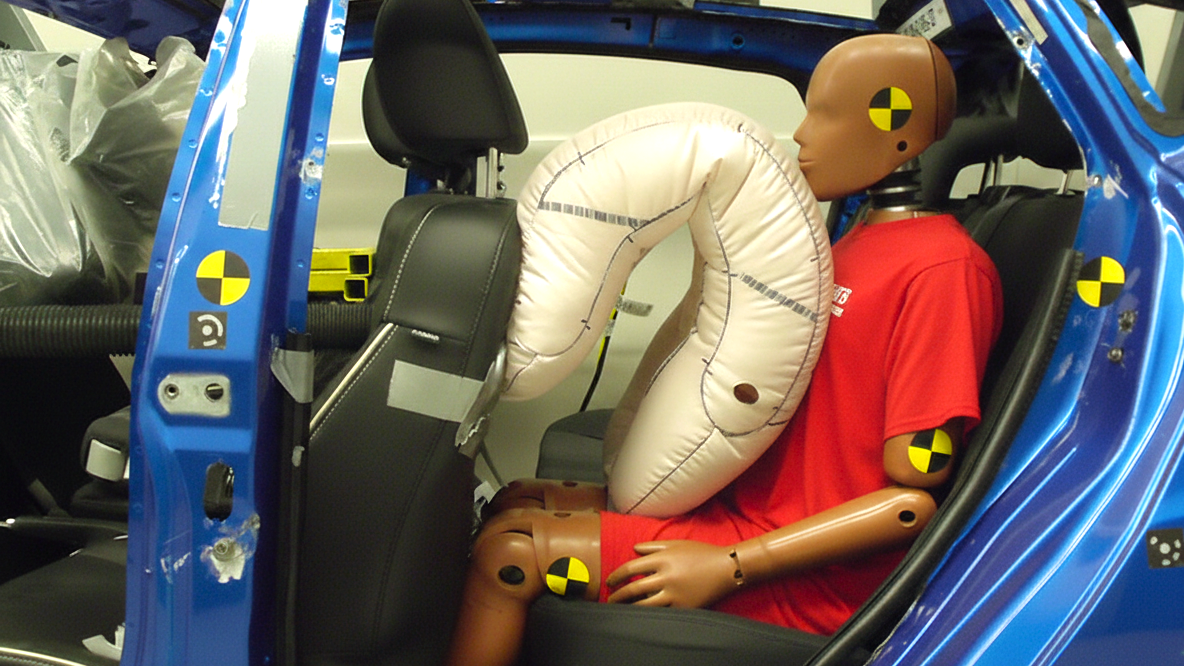
In recent years, SRS has become noticeably “smarter.” Manufacturers have moved away from a universal “deploy at maximum” scenario and switched to controlled strategies. This is especially important because people sit differently, and crashes vary in severity.
- Multi-stage deployment and inflation force control. In some systems there are two stages: for a lighter crash the first stage fires; for a severe crash the second stage is added. This reduces the risk of injuries from the airbag itself while maintaining protection in serious crashes.
- Adaptation to height, weight, and position. The ECU uses seat occupancy sensors and sometimes the distance to the steering wheel/dashboard, seat position, and belt use. If the passenger is too close, the logic may change the deployment strategy or disable the front passenger airbag under certain conditions (depending on legislation and the manufacturer’s implementation). The idea is simple: it is better for the system not to be aggressive if a person is in an unsafe zone.
- Integration with belts and pretensioners. In modern cars, the belt “engages” first: the pretensioner removes slack, secures the body, and helps it take the correct position relative to the airbag. Then load limiters come into play to reduce the risk of chest injury. Together this works as a single scenario: the belt holds, the airbag cushions and distributes the load.
- Development of side protection. From the standpoint of injury severity, a side impact remains one of the most dangerous—there is little crumple zone. That is why curtains and side modules have become standard for many vehicle classes. The effectiveness of such solutions is confirmed by IIHS research showing reduced risk of fatal outcomes in a driver-side impact.
The overall result of technological development: the system increasingly “adapts” to the situation instead of acting the same way for everyone.
Important recommendations for drivers and passengers
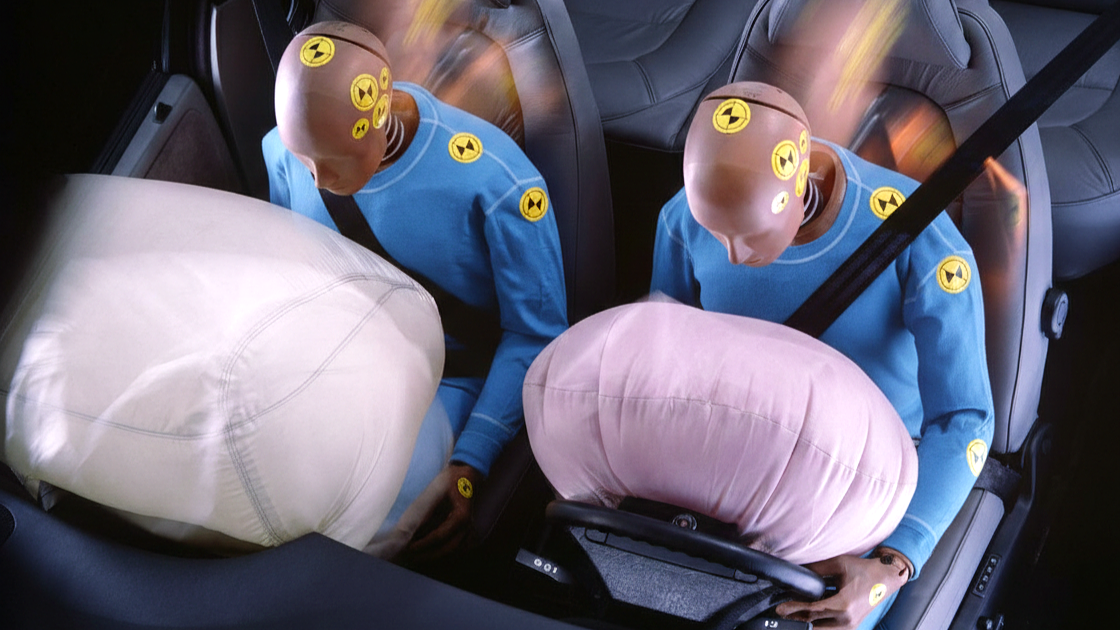
Correct seating position and basic checks produce a real effect—sometimes greater than the difference between “two airbags” and “six.” There is no need for complex rules here; what matters is discipline and understanding the logic of operation.
- Distance to the steering wheel and dashboard. The driver should sit so that the chest is not too close to the steering wheel: the airbag deploys toward the person, and with a short distance the contact is too harsh. Typically, a safe distance of about 25 cm or more is used as a guideline (the exact value depends on the vehicle and seating, but the principle is one—do not lean onto the steering wheel).
- Seat belt—always. The airbag is designed for a belted person. The belt holds the body and sets the correct trajectory, while the airbag reduces overloads and the risk of striking interior parts.
- Hand position. If you hold your hands high on the steering wheel and close to the module, deployment can injure the wrists/forearms. A rational steering technique reduces risk.
- SRS warning light on the dashboard. If the airbag/SRS indicator is on or flashing, it is not a “minor issue.” The system may be disabled or operating incorrectly. Diagnostics with a scanner and checks of circuits, connectors, sensors, and the control unit are needed.
- Child seats and the front passenger seat. A rear-facing child seat in the front passenger position is allowed only with the front passenger airbag disabled and with strict compliance with the manufacturer’s instructions. That is why vehicles have warnings, and regulations separately describe requirements for such zones.
- Be careful with interior tuning. Steering wheel re-trimming, installing non-standard dashboard covers, non-original seat covers, and interference with wiring are typical reasons why an airbag may deploy incorrectly or may not deploy at all. If there are side airbags in the seats, covers must be compatible with SRS and have weakened seams in the deployment zone.
The professional approach is simple: keep the factory configuration of deployment zones, monitor SRS indications, and do not try to “fix” faults with resistors and deactivations. This is a system you may need once in your life—but at that moment it must be functional.
Conclusion
Airbags are one of the most important elements of passive protection: they help reduce the severity of injuries in the first milliseconds of a crash, when overloads are at their highest. Technology continues to evolve—systems become adaptive and more accurately “read” the crash scenario, which means air bags in cars over time will work even more effectively, complementing seat belts and the body’s structural framework.

